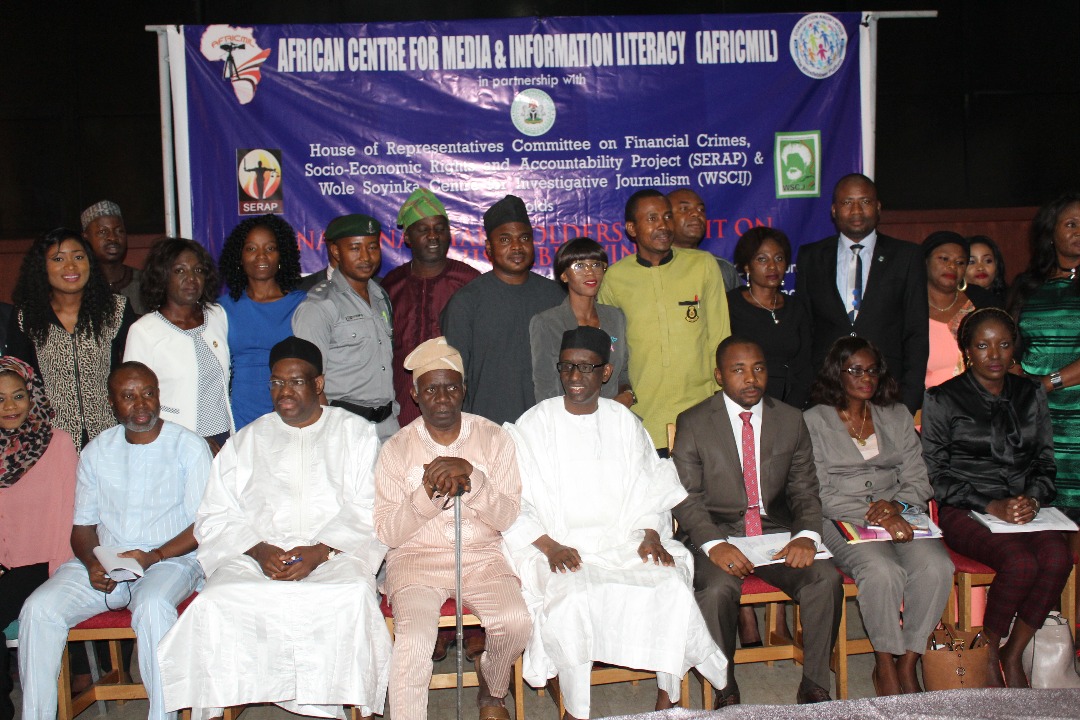
The National Stakeholders Summit on whistleblowing was held in Abuja on Tuesday, November 14, 2017. The summit organized by the African Centre for Media and Information Literacy (AFRICMIL), in partnership with the House of Representatives Committee on Financial Crimes, Socio-economic Rights and Accountability Project (SERAP) and the Wole Soyinka Centre for Investigative Journalism (WSCIJ) aimed to enhance collaboration in the fight against corruption and improve the effectiveness of whistleblowing in anti-corruption in Nigeria.
Over 80 participants from anti-corruption institutions, government agencies, civil society organisations and the media, attended the summit which featured speakers and experts on anti-corruption.
The summit chaired by Mallam Nuhu Ribadu, pioneer Chairman of the Economic and Financial Crimes Commission (EFCC) featured a keynote address by Mr. Femi Falana, SAN, and two more presentations by Waziri Adio, Executive Secretary, Nigeria Extractive Industries Transparency Initiative ((NEITI) and Prof. Abdullahi Shehu, immediate past Director General of GIABA, the Inter-Governmental Action Group Against Money Laundering in West Africa.
The paper by the NEITI Executive Secretary who was represented by Dr. Dauda Garuba explored opportunities for whistleblowing in the extractive industry in Nigeria while Abdullahi’s paper was a critique of the experience of whistleblowing in Nigeria since the introduction of the policy by the Federal Government in December 2016.
At the end of the robust presentations and discussions that followed, the summit made the following critical observations and recommendations expected to improve collaborative effort in whistleblowing and sustain the gains of the whistleblowing policy in Nigeria.
OBSERVATIONS
- That the whistle-blower policy is a critical and promising anticorruption tool capable of enhancing citizens’ involvement and revamping anticorruption efforts in Nigeria.
- That the absence of proper legal backing and lack of adequate protection for potential whistleblowers is a serious constraint to the effectiveness of whistleblowing in Nigeria and a threat to public confidence in the policy.
- That there is urgent need for a properly defined independent governance structure for managing recoveries made through whistleblowing to ensure transparency and accountability.
- That the delay in the passage of the whistle-blower protection bill currently locked in legislative processes in the National Assembly along with other major anti-corruption bills are major threats to current anti-corruption efforts in Nigeria.
- That the delay on the part of the Federal Government in constituting the Boards of parastatals and MDAs, including some anticorruption agencies, in the past two years, is hampering the fight against corruption.
- That states and local governments across the country have not shown sufficient interest and support for the anti-corruption stance of the current administration by not replicating key policies in this regard.
- That there is no uniformity of purpose in the fight against corruption by the ruling political party and among key government officials.
- That there is no coordination in the fight against corruption among the various anti-corruption and security agencies.
- That from independence to date, Nigeria has failed to put in place mechanisms that enable the country to adequately account for the revenues from extractive industry which constitute about 85% of the country’s revenue.
- That civil society groups are not adequately involved in the implementation of whistleblower policy, which makes it difficult to optimize citizens involvement.
- That the private sector has not taken advantage of the whistleblower policy.
- That whistle-blowers have become victims of their own patriotic acts in view of the delay of the government to speedily reward them in accordance with the policy or protect them against punitive actions.
RECOMMENDATIONS
Based on the observations above, the Summit recommended as follows:
- Government should urgently finalize legislation to protect whistleblowers and their relations, which will bolster public confidence and support for the policy.
- Measures should be urgently put in place by relevant agencies to address the security of whistle-blowers and resolve cases of persons who are persecuted for giving out information.
- There is urgent need for government to set up independent governance structure comprising representatives of anti-corruption agencies and credible Civil Society Organisations (CSOs) to oversee the implementation of the whistleblower policy.
- The National Assembly should hasten up the passage of the whistle-blower protection and other relevant bills that will support the fight against corruption.
- That in addition to ensuring their safety and protection, government should motivate whistle-blowers by prompt payment of their entitlements.
- States and local governments across the country should immediately take the initiative to address grand and retail corruption prevalent at those levels of governance. One way to do that is to quickly adopt the whistleblower policy.
- Government should ensure appropriate coordination and cooperation among the anti-corruption and security agencies in the fight against corruption for greater success.
- Government should take adequate steps to address the lack of effective transparency and accountability in the extractive industry, by making use of the whistle-blowing opportunity.
- That private sector operators should not see the whistle blower policy as only applicable to government agencies, and should devise means to adopt in line with global best practice.
- That the whistle-blowing initiative should be of interest to development partners working to support the fight against corruption in Nigeria.
- Civil Society groups are key to the fight against corruption and should be adequately involved in the initiation and implementation of anti-corruption policies of government.
CONCLUSION
The summit commended the Federal Government for the signing on to the Open Governance Partnership (OGP) and other international instruments to aid the fight against corruption.
The summit appreciated the government’s whistleblowing initiative and expressed satisfaction with the results achieved in the fight against corruption through information provided by whistle blowers.
It commended whistle-blowers for their patriotism in volunteering information, as well as civil society and media for their roles in taking up cases of victimized whistle blowers and advocating for a corruption-free Nigeria.
Finally, the summit noted the role of The John D. and Catherine T. MacArthur Foundation in supporting the fight against corruption in Nigeria.
SIGNED:
Muhuyi Magaji Rimin-Gado
Chairman, Kano State Public Complaints & Anticorruption Commission
Ibrahim M. Zikirullahi
Resource Centre for Human Rights & Civic Education (RCHRCE)
Godwin Onyeacholem
African Centre for Media & Information Literacy (AFRICMIL)
Participating organisations:
NGOS/CSOs
- African Centre for Media & Information Literacy (AFRICMIL)
- National Open University of Nigeria (NOUN).
- Resource Centre for Human Rights & Civic Education (RCHRCE).
- International Federation of Women Lawyers (FIDA)
- Centre for Anti-corruption and Open Leadership (CACOL)
- Progressive Youth Initiative of Nigeria (PYIN).
- United Nations Educational, Educational, Scientific and Cultural Organization (UNESCO).
- Amnesty International (AI).
- Public Interest Lawyers League (PILL).
- Stakeholder Democracy Network (SDN).
- Oyo State Advocacy for Qualitative Representation.
- Advocacy for Change Initiative.
- Social Development Integrated Centre (Social Action).
- Youth Media and Communication Initiative (YMCI).
- Global Initiative for Good Governance.
- The Partnership Centre (TEP).
- UNESCO Youth Forum, Nigeria.
- Application Program Interface (API).
- Moving Image Limited.
- Civil Society Legislative Advocacy Centre (CISLAC).
- CC Anti-Climate.
- Zero Corruption Coalition (ZCC).
- International Centre for Investigative Reporting (ICIR).
- Human and Environmental Development Agenda (HEDA).
- Basic Rights Action (BRA).
- Nigeria Bankers Games (NBG)
- Integrity Organisation
Ministries Departments and Agencies (MDAs)
- Nigeria Extractive Industries Transparency Initiative (NEITI)
- Federal Ministry of Solid Material
- Federal Ministry of Justice
- High Court of Justice
- Nigeria Police Force
- Federal Ministry of Budget & National Planning
- Nigeria Security and Civil Defence Corps (NSCDC)
- Nigeria Customs Service
- Nigerian National Petroleum Commission
- National Agency for the Prohibition of Trafficking in Person (NAPTIP)
- Kano State Public Complaints & Anticorruption Commission
- Presidential Advisory Committee Against Corruption (PACAC)
- Independent Corrupt Practice and Other Related Offences Commission (ICPC)
MEDIA
- Africa Independent Television (AIT)
- The Punch Newspaper
- Blueprint Newspaper
- Nigerian Television Authority (NTA)
- Independent Television
- The Sun Newspaper
- The Independent Newspaper
- Sahel Standard Newspaper
- TV360News
- New Telegraph
- The Nation Newspaper
- Cool Wazobia International
- Premium Times
- News Agency of Nigeria
- OrderPaperng
- Avilla Media Ltd
THIS COMMUNIQUE WAS ISSUED AT THE END OF A ONE-DAY NATIONAL STAKEHOLDERS SUMMIT ON WHISTLEBLOWING ORGANISED BY THE AFRICAN CENTRE FOR MEDIA AND INFORMATION LITERACY (AFRICMIL), IN COLLABORATION WITH THE HOUSE OF REPRESENTATIVES COMMITTEE ON FINANCIAL CRIMES, SOCIO-ECONOMIC RIGHTS & ACCOUNTABILITY PROJECT (SERAP) AND THE WOLE SOYINKA CENTRE FOR INVESTIGATIVE JOURNALISM (WSCIJ), on Tuesday, November 14, 2017, at ROCKview RoyAle Hotel, Abuja.
